
Glossary of Window and Glazing Terms
Image: AI-generated by GlassBase
Short definitions of terms you will see on window labels, in the ENERGY STAR criteria and in the GlassBase window energy calculator. Each one names its source. For how the ratings fit together, see Window energy ratings in the US.
AAMA Gold Label
A certification label from the AAMA Gold Label Certification Program, run by the Fenestration and Glazing Industry Alliance (FGIA). A sample of the product is tested to the North American Fenestration Standard, and two unannounced plant inspections each year check ongoing production. Source: [7]
Air leakage (AL)
The volume of air that flows through a window, door or skylight per unit time and area because of a pressure or temperature difference, measured in cfm/ft². Lower is tighter; ENERGY STAR Version 7.0 requires 0.3 cfm/ft² or less for windows. Sources: [1], [3]
Certified Products Directory (CPD)
A public list of certified products. NFRC's CPD lists products with NFRC-certified energy ratings; FGIA's CPD lists products certified under the AAMA Gold Label program. Sources: [5], [8]
Chromogenic glazing
Glazing that can reversibly change its optical properties. The materials can be active (such as electrochromic or suspended particle devices) or passive (such as photochromic or thermochromic). Source: [1]
Climate zone (ENERGY STAR)
One of four US regions used by ENERGY STAR for windows: Northern, North-Central, South-Central and Southern, each with its own U-factor and SHGC limits. Zones are listed by state and county, and in some places by ZIP code. Sources: [1], [13]
Condensation resistance (CR)
How well a window resists moisture forming on its interior surface, scored from 0 to 100. Higher is better. It is an optional rating on the NFRC label. Sources: [2], [6]. To check whether moisture forms on a window's glass at your indoor humidity, use the window condensation calculator.
Door (ENERGY STAR)
A sliding or swinging entry system in a wall between conditioned and unconditioned space. ENERGY STAR groups doors by glazing level: opaque, ½-lite or less (up to 900 in² of glass) and more than ½-lite. Source: [1]
Dynamic glazing product
A window, door or skylight that can fully reversibly change its U-factor, SHGC or visible transmittance, for example with chromogenic glass or blinds between the panes. Source: [1]
ENERGY STAR
A US Environmental Protection Agency program. For windows, it requires NFRC-certified U-factor and SHGC ratings that meet the limits for a climate zone, plus certification by a certification body recognized by EPA. Source: [1]
Equivalent energy performance
An alternative ENERGY STAR path for windows in the Northern zone only: a U-factor of 0.23 to 0.26 qualifies if the SHGC is at least 0.35 or 0.40, depending on the U-factor. Source: [1]
Fenestration
Windows, doors and skylights in a building envelope. They provide light, warmth and ventilation but have a lower R-value than opaque walls. Source: [3]
Gas fill (argon, krypton)
A nontoxic gas such as argon or krypton that fills the space between the glass panes and insulates better than air. Source: [4]
Insulating glass unit (IGU)
A preassembled unit of glass panes sealed at the edges and separated by dehydrated space. ENERGY STAR requires IGUs to be certified under NFRC procedures. Source: [1]
Internal shading system
Operable blinds or shades between the glass panes of a window, door or skylight. Source: [1]
Light-to-solar gain (LSG)
The ratio between SHGC and visible transmittance, a gauge of how well a glazing type admits daylight while blocking solar heat. A higher number means more daylight comes in without as much solar heat. It is not always provided. Source: [3]
Low-E coating
A low-emissivity coating on the glass that blocks radiant energy but lets visible light through. It also helps protect furnishings from fading. Source: [4]. More: Low-E glass guide.
NAFS (North American Fenestration Standard)
The common name for AAMA/WDMA/CSA 101/I.S.2/A440, the standard that covers performance such as air leakage, water penetration and structural resistance. Products certified under the AAMA Gold Label program must meet it. Sources: [1], [7]
NFRC (National Fenestration Rating Council)
An independent, nonprofit certification body for the energy performance of windows, doors and skylights. Its ratings combine computer simulation with physical testing, and a laboratory and an inspection agency are both involved. Sources: [5], [9]
NFRC label
The label that shows a product's NFRC-certified energy ratings. U-factor, SHGC and visible transmittance are mandatory; air leakage and condensation resistance are optional. Sources: [3], [6]. More: reading the NFRC label.
Residential building (ENERGY STAR)
A building used mainly for living and sleeping, zoned residential or subject to residential codes. For ENERGY STAR it means buildings of three stories or less. Source: [1]
Sidelite
A fenestration product with the NFRC product code FXSL. ENERGY STAR includes sidelites in its door category and groups them by glazing area. Source: [1]
Skylight
A window designed for sloped or horizontal installation in a roof, mainly for daylight or ventilation. Source: [1]
Sliding glass door
A door with one or more manually operated glass panels that slide horizontally in a common frame, NFRC product code DDSG. ENERGY STAR rates it by climate zone, like a window. Source: [1]
Solar heat gain coefficient (SHGC)
The fraction of solar radiation admitted through a window, either transmitted directly or absorbed and released as heat inside, on a scale of 0 to 1. A low SHGC reduces summer cooling loads; a high SHGC collects more solar heat in winter. Sources: [1], [3]
Spacer
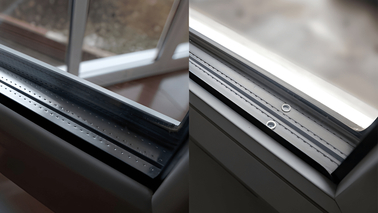
The component that keeps the glass panes of an insulating glass unit the correct distance apart. Insulating spacers reduce heat flow at the edge of the glass. Source: [4]. More: Spacers and window energy efficiency.
Swinging door
A door attached by a hinge or pivot so that the leaf rotates to open and close; NFRC codes EDSL and DDFR. Source: [1]
TMY3 (Typical Meteorological Year, version 3)
NREL data sets of hourly solar radiation and weather for one typical year at 1,020 locations in the United States and its territories. Each year is built from 12 typical months. The GlassBase calculator uses TMY3 data from 1,010 stations. Sources: [10], calculator methodology
Transom
A fenestration product with the NFRC product code FXTR. ENERGY STAR includes transoms in its window category. Source: [1]
Tubular daylighting device (TDD)
A fixed device that brings daylight from the roof to a ceiling through a tube with a reflective inside surface. ENERGY STAR treats TDDs as skylights. Source: [1]
U-factor
The rate of heat flow through a window per unit area and per degree of temperature difference, in Btu/(h·ft²·°F). NFRC U-factors cover the whole product, including frame and spacer. Lower is better. One Btu/(h·ft²·°F) equals 5.678 W/(m²·K). Sources: [1], [3], [12]
Uw, Ug, Uf and Ψ (psi)
Symbols used in ISO 10077-1 calculations: Uw for the whole window, Ug for the glass, Uf for the frame, and Ψ for the extra heat flow along the glass edge, in W/(m·K). The GlassBase calculator combines them as Uw = (Uf × Aframe + Ug × Aglass + Ψ × glass perimeter) / total area. Sources: [11], calculator methodology
Visible transmittance (VT)
The fraction of visible sunlight, weighted by the sensitivity of the human eye, that passes through the glazing, on a scale of 0 to 1. Higher means more daylight. Source: [3]
Window (ENERGY STAR)
An assembled unit of a frame or sash holding one or more pieces of glazing, installed vertically in an exterior wall of a residential building to admit light or air. Source: [1]
Sources
- US EPA, ENERGY STAR, Residential Windows, Doors, and Skylights Eligibility Criteria, Version 7.0
- US EPA, ENERGY STAR, Independently tested and certified energy performance
- US DOE, Building Science Education, Fenestration – Define Key Terms and Fenestration module
- US DOE, Building Science Education, High-Performance Window Systems: Glass
- NFRC, nfrc.org
- NFRC consumer guide, Window ratings
- FGIA, AAMA Gold Label Certification Program
- FGIA, Certified Products Directory
- NFRC, Residential product certification
- NREL, Users Manual for TMY3 Data Sets
- ISO, ISO 10077-1:2017
- NIST, Guide to the SI, Appendix B.9
- US EPA, ENERGY STAR, Climate zone finder

Other related articles
Window Spacers and Energy Efficiency

Low-Emissivity (Low-E) Glass
Get our latest articles!


Subscribe to updates
Get the latest guides and industry news delivered to your inbox.