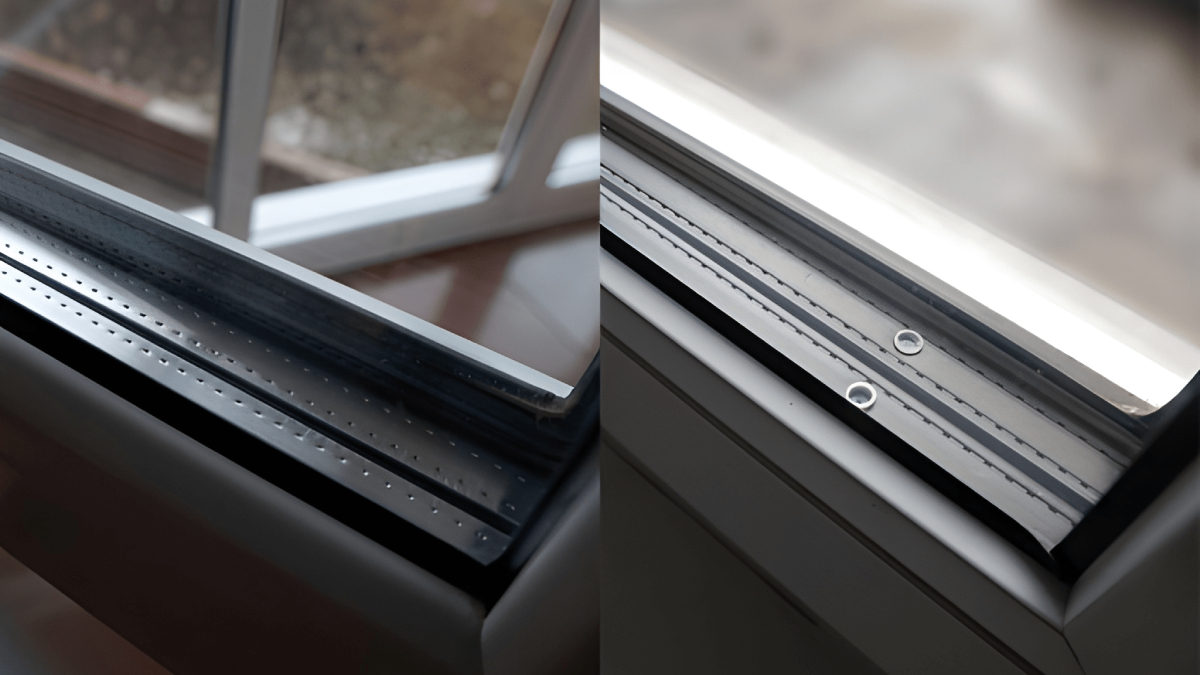
Window Spacers and Energy Efficiency
GlassBase.com
A window consists of a glass unit, a frame profile, and hardware. The glass unit itself includes another component that has an outsized effect on the whole assembly's performance: the spacer — the bar or strip that separates the panes of glass in an insulated glass unit (IGU).
Energy efficiency depends on the balanced performance of every component. Underperformance in even one part — including a part as small as the spacer — can undercut the investment made in an otherwise energy-efficient window.
In the U.S. residential market, window energy performance is rated primarily by U-factor, a measurement developed and administered by the National Fenestration Rating Council (NFRC) and used by the EPA's ENERGY STAR program and the U.S. A lower U-factor means better insulating performance. Every NFRC-certified window carries a label showing U-factor along with Solar Heat Gain Coefficient (SHGC), visible transmittance, air leakage, and — on many labels — a condensation resistance score.
To lower U-factor, manufacturers have moved toward multi-pane IGUs with wider gas-filled cavities, argon or krypton gas fills, one or more low-emissivity (low-E) coated panes, and more durable multi-layer edge seals. Overall IGU thickness varies significantly by manufacturer and application — commonly ranging from about 1/2 inch to 1 1/2 inch — with full-performance argon-filled triple glazing typically falling in the roughly 1 3/8 to 1 1/2 inch range, according to building-science publication GreenBuildingAdvisor. Whatever combination of features is used, a traditional aluminum spacer in the IGU becomes what the industry calls a "cold bridge" — a path of reduced thermal resistance that can significantly undercut the window's overall insulating performance and increase the likelihood of condensation at the edge of the glass.
What Spacers Do
In an IGU, the sealed air or gas space between panes is central to the unit's insulating performance. Spacers hold the panes at a fixed distance from one another, forming the sealed cavity along the entire perimeter of the unit. As defined by NFRC, a spacer is the component that separates and maintains the space between the glazing surfaces of an IGU, not including the sealants around it.
Spacers also typically contain a desiccant — commonly a molecular sieve material with a very fine, uniform pore size (around 3 angstroms), sometimes blended with silica gel — that absorbs moisture that migrates into the sealed cavity over time. According to Cardinal Glass Industries, a leading U.S. glass fabricator, molecular sieve desiccants with this pore size are chosen because they absorb water vapor selectively without also drawing in the argon or krypton fill gas, which would otherwise unbalance the unit and stress the seals. Insufficient or lower-capacity desiccant is one recognized cause of interior condensation ("fogging") inside an IGU over its service life.
Types of Spacers
Spacers are broadly grouped into "cold" (metal) and "warm" (low-conductivity) categories.
Aluminum spacers ("cold")
- A long-established, widely used technology that most fabricators are highly experienced in working with.
- Low material and production cost.
- Highly thermally conductive, which creates a continuous thermal bridge at the perimeter of the IGU — generally the coldest zone in the window — and increases the risk of condensation along the edge of the glass. This effect is documented by multiple spacer manufacturers and technical sources, including Technoform and Edgetech.
Example: Standard extruded aluminum spacer bar — a commodity component used industry-wide rather than a single branded product.
Other related articles

Low-Emissivity (Low-E) Glass
Get our latest articles!
New and better



Subscribe to updates
Get the latest guides and industry news delivered to your inbox.