
The Blower Door Test (ASTM E779): A Buyer's Guide to Whole-Home Airtightness
Flickr user Brandon Stafford
If you're replacing windows or building a new home, you'll likely run into the term "blower door test." Builders mention it. Energy raters require it. Local codes often mandate it. This guide explains what the test measures, how it works, and how it differs from the smaller lab test manufacturers run on individual window and door units.
What a Blower Door Test Measures
A blower door test checks how much air leaks through a home's entire building envelope — walls, roof, foundation, and every window and door installed in it. ASTM International publishes the governing standard, ASTM E779, titled Standard Test Method for Determining Air Leakage Rate by Fan Pressurization. The test measures airtightness and unintended air leakage across the whole building envelope, and technicians calculate a leakage rate expressed in cubic feet per minute per square foot of envelope area at a set reference pressure.
Two related standards cover similar ground. ASTM E1827 offers a comparable method using an orifice-style blower door, and building professionals turn to it when a project needs a building-specific pressure exponent rather than an assumed one. A third standard, ASTM E783, applies specifically to field testing of an individual installed window or door rather than a whole building. Codes and rating programs across the country accept E779, E1827, or both for whole-house testing.
How the Test Works
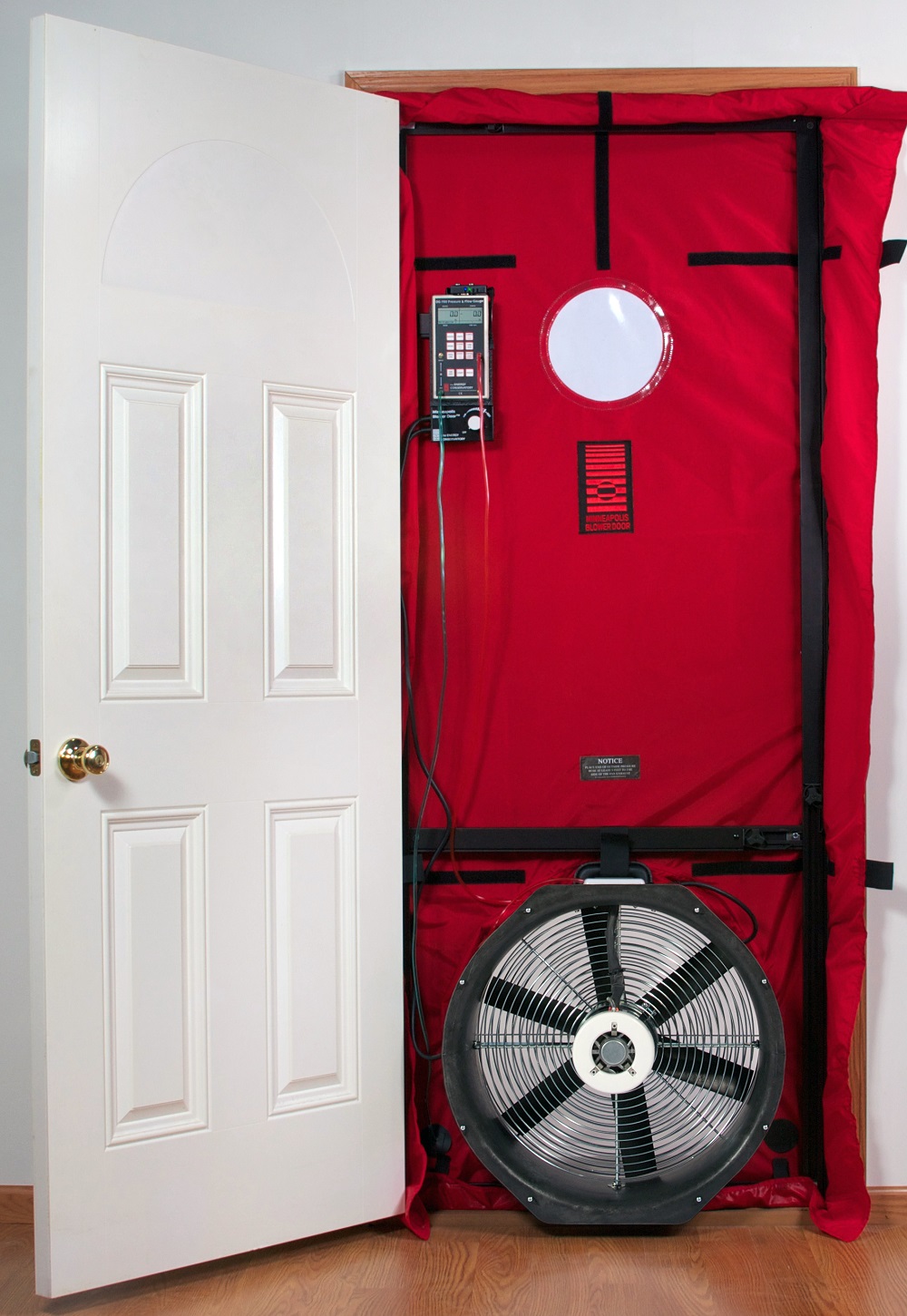
A technician mounts a calibrated fan inside a temporary frame that fits into an exterior doorway. With every window and door shut and combustion appliances shut off, the fan pulls air out of the house. As indoor pressure drops, outside air pushes in through every gap, crack, and seam in the envelope — including window and door frames, sill plates, and roof-to-wall joints.
The technician raises fan speed step by step and records airflow at each pressure reading. According to the U.S. Department of Energy's Building America Solution Center, an enclosure air leakage test produces a measurement of airflow at a standard pressure of 50 pascals between the conditioned space and the outside, expressed as cubic feet per minute at 50 Pa, or CFM50. Dividing that figure by the home's volume gives the air changes per hour at 50 Pa, or ACH50 — the number you'll see on a test report and on most energy code compliance forms.
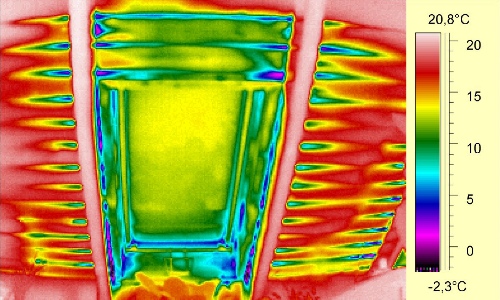
Auditors sometimes pair the test with a smoke pencil or an infrared camera to pinpoint exactly where the leaks are, not just how large they are in total.
Who Requires the Test — and What Passing Looks Like
Air leakage testing has been part of the International Energy Conservation Code (IECC) since the 2012 edition, and it remains mandatory in the 2018 and 2021 versions. The 2021 IECC requires the test to run at 50 pascals, with a maximum result of 3.0 air changes per hour to pass. Limits shift by climate zone under some adopted codes: the 2021 IRC sets a base limit of 3 ACH50 for Climate Zones 3 through 5, 4 ACH50 for Zones 0 through 2, and 2.5 ACH50 for Zones 6 through 8. States and cities frequently adjust these numbers, so the local adopted code — not the model code — sets the actual pass/fail line for a given project.
Testing must come from a qualified party. RESNET-certified home energy raters, or professionals credentialed through the Building Performance Institute, typically perform the test and follow RESNET's published testing chapter for the procedure. A builder generally cannot self-certify results unless the local jurisdiction specifically allows it.
Blower Door Test vs. Laboratory Air Leakage Test (ASTM E283)
Buyers sometimes confuse the whole-house blower door test with the air leakage rating printed on a window's NFRC label. That rating comes from a different standard entirely: ASTM E283, Standard Test Method for Determining Rate of Air Leakage Through Exterior Windows, Skylights, Curtain Walls, and Doors Under Specified Pressure Differences Across the Specimen.
The two tests share a basic principle — push a pressure difference across a barrier and measure the airflow that gets through — but they differ in scope, setting, and purpose.
Where it happens. ASTM E283 is a laboratory procedure conducted at constant temperature and humidity. A manufacturer sends a single window or door unit to an accredited lab, where it's mounted in a test chamber rather than a finished wall. Field testing of an already-installed window or door instead falls under ASTM E783, which references E283 as its laboratory counterpart.
What gets measured. E283 isolates one product. Technicians install the window or door assembly in a test frame and subject it to a standardized static pressure difference, then measure the volume of air that passes through the unit itself. A blower door test under E779, by contrast, captures every leak path in an entire building at once — window seals, but also framing gaps, electrical penetrations, and duct chases — and reports one combined number for the whole envelope.
Test pressure. E283 commonly runs at a standard pressure of 1.57 psf, or 75 pascals, though a test lab may use higher pressures depending on the application or local code. Blower door tests under E779 typically report results at 50 pascals, the pressure difference codes and rating programs use as their common reference point.
What the result tells you. An E283 result becomes the air infiltration rating on a window's NFRC label, and it lets you compare one product's factory-tested performance against another's before you buy. It says nothing about how that window performs once a crew installs it, and it says nothing about the rest of the house. A blower door result tells you how the finished building performs as a system, including installation quality — a well-rated window with a sloppy rough-opening seal can still leak.
Where Each Test Fits in a Project
Use the E283 rating on a manufacturer's spec sheet to compare products during selection. A lower cfm/ft² number means a tighter unit before it ever leaves the factory. Once that window is installed, only a blower door test under E779 confirms whether the installation — flashing, sealant, backer rod, shims — holds up to the manufacturer's lab number. Many energy retrofit and rebate programs require both: product-level documentation from E283 testing at purchase, and a whole-house E779 test before and after work to confirm the envelope actually tightened up.
Bottom Line for Buyers
A window's NFRC label tells you what the product can do in a lab. A blower door test tells you what your house actually does once that product is installed. If you're chasing an energy code sign-off, a rebate, or simply a warmer, quieter home, the blower door test — not the label — is the number that counts.
Other related articles
Window Spacers and Energy Efficiency

Low-Emissivity (Low-E) Glass
Get our latest articles!
New and better



Subscribe to updates
Get the latest guides and industry news delivered to your inbox.