How to Read a Miami-Dade NOA and a Florida Product Approval
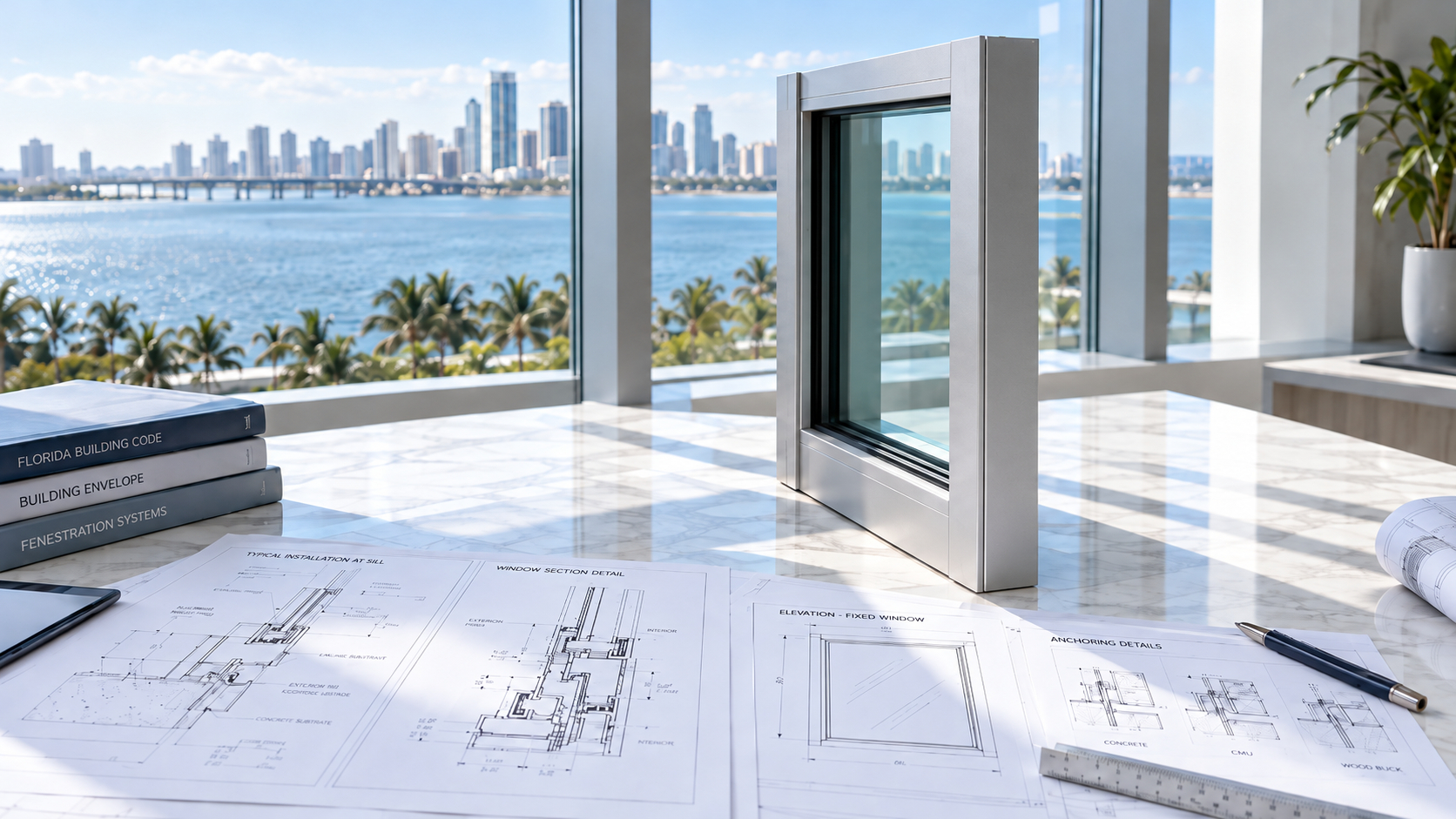
Image: AI-generated by GlassBase
A Miami-Dade Notice of Acceptance (NOA) and a Florida Product Approval (FL#) answer the same questions about a window or door: is the approval current, is the product approved for the High-Velocity Hurricane Zone (HVHZ), is it impact resistant, and what design pressure is it rated for? The search result gives the headline numbers. The limits for a specific window, such as size, glass and anchors, are in the drawings attached to the approval, so read those before you compare a product with what your openings require. For how the two systems fit together, see Florida impact windows.
Updated: October 2026.
Where to look up the number
NOA: use Miami-Dade County's Product Control Search. Basic Search takes a file number in the format 25-0304.05. Advanced Search filters by file classification, applicant, category, subcategory, material, impact rating and maximum design pressure (+ and −).
FL#: use the Florida Building Commission's Product Approval search. Enter the FL# with the code version. Application numbers have the format ##### and product numbers #####.#. The search page notes that "the code version is the 2023 Florida Building Code which became effective December 31, 2023."
The NOA search result, field by field
| Field | What it tells you |
|---|---|
| NOA | The file number, linked to the full NOA as a PDF |
| File Status | Whether the NOA can be used (see below) |
| Superseded_By | A newer NOA, if the file has been revised |
| File Classification | "High velocity hurricane zone" or "Non-High velocity hurricane zone" |
| Category, Subcategory, Material | For example Windows, Double Hung - Single Hung, Aluminum |
| Applicant | The company that holds the approval |
| Expiration_Date | The last day the approval is valid |
| Impact_Rate | Large and Small Missile Impact, Large Missile Impact, Small Missile Impact, Large Missile & Level E, or none |
| Maximum_Design_Pressure_Positive / Negative | The highest positive and negative design pressures in the approval |
| Description | The product series and type |
Miami-Dade's file status key defines the statuses you are most likely to see:
- File Approved: "NOA is valid and can be used."
- Superseded: "NOA has been revised and a newer one exists. The NOA can still be used until expiration date."
- NOPA to Remove Issued: the NOA "is in the process of being removed."
- File Closed: "NOA is no longer valid," for example after a loss of quality assurance, a product found out of compliance with the NOA, or a discontinued product.
- Expired: "NOA is no longer active."
Miami-Dade says first-time approvals and renewals are each "valid for five years," so an NOA can expire in the middle of a project. Check the date. Treat the maximum design pressure as the top of a range: in the window NOA we reviewed, the rating for a given unit depended on its glass, configuration and size.
Inside the NOA document
We read a current NOA for an impact-resistant single-hung window, approved June 12, 2025 and expiring July 30, 2030. Drawings differ by product, but page 1 of an NOA follows a standard layout:
- Scope. The NOA is accepted "to be used in Miami Dade County and other areas where allowed by the Authority Having Jurisdiction (AHJ)" and "shall not be valid after the expiration date stated below."
- Approval document. The drawing set that forms the approval, with its number, revision and date, signed and sealed by a professional engineer and stamped by Product Control.
- Missile impact rating. Here, "Large and Small Missile Impact Resistant."
- Labeling. Each unit must carry a permanent label that includes the model or series and the statement "Miami-Dade County Product Control Approved."
- Termination. The NOA ends at its expiration date or if the product's materials, use or manufacture change.
- Inspection. A copy of the entire NOA must be provided to the user and "be available for inspection at the job site at the request of the Building Official."
The evidence pages (E-1, E-2 and so on) list what the approval rests on. Here that meant tests to the Florida Building Code's TAS protocols: TAS 201 (large missile impact), TAS 202 (air infiltration, static air pressure, water resistance and forced entry) and TAS 203 (cyclic wind pressure), glass checked under ASTM E1300, anchor calculations, and quality assurance by the county.
The drawings are where a buyer finds the limits. In this NOA the general notes say shutters "are not required when used in wind-borne debris regions" and that some glass types may not be used in the HVHZ above 30 feet. The user instructions set out the method: find the design pressure the opening requires from ASCE 7, choose anchors for the installation conditions, then read the window's rated design pressure for its glass, configuration and size. That rating "must equal or exceed the design pressure requirement for the window opening."
The Florida Product Approval record
A record on floridabuilding.org starts with the FL#, the application type (new, revision, affirmation or editorial change), the code version and the application status. It then names the manufacturer, the product category, the compliance method, the quality assurance entity with its contract expiration date, and the test standards the approval references. In the door record we reviewed, those included TAS 201, 202 and 203 and ASTM E1886 and E1996. The dates submitted, validated and approved come next.
The product summary gives each product its own FL# (#####.#) and a "Limits of Use" block: approved for use in the HVHZ (yes or no), approved for use outside the HVHZ (yes or no), impact resistant (yes or no), design pressure (for example +85/−85), and an "Other" line. In our example the "Other" line pointed to the installation drawings for sizes and options versus design pressure. Links to the installation instructions and the evaluation report sit beside it. Open both, and find the size you are buying.
Design pressure is not a performance grade
Both records list design pressure (DP). Some quotes also cite a performance grade (PG) under the North American Fenestration Standard, AAMA/WDMA/CSA 101/I.S.2/A440. The Fenestration and Glazing Industry Alliance (FGIA) says the 2008 edition of the standard clarified the difference "because some manufacturers were marketing products solely based on the design pressure (DP) rating." In FGIA's words, "PG means that the product was tested to the applicable design pressure as well as all the other requirements identified by the standard/specification." If a seller quotes a PG, ask for the certification that backs it.
A quick check before you sign
- Get the NOA number or FL# for every window and door in the quote, and look each one up.
- Confirm the approval is current and its expiration date covers your project.
- In Miami-Dade or Broward, confirm HVHZ approval. Everywhere, confirm impact resistance or ask which approved shutters will protect the openings.
- Compare each unit's rated design pressure, at its actual size and glass, with the pressure its opening requires.
- Ask the installer to follow the approval's installation drawings, anchors included.
Find window companies in South Florida
Miami-Dade County: Miami, Miami Beach, Hialeah, Homestead. Broward County: Fort Lauderdale, Hollywood, Pompano Beach. Elsewhere in Florida: Boca Raton, Orlando, St. Petersburg, Jacksonville.
GlassBase is an independent directory and does not sell or install windows. Company profiles show information as reported by each company, so verify approvals and licenses at the official sources.
Sources
- Miami-Dade County, Product Control Search (file number format; advanced search fields; impact rating values). Fetched October 7, 2026.
- Miami-Dade County, NOA File Status Key. Fetched October 7, 2026.
- Miami-Dade County, Product Approval (approvals and renewals valid for five years). Fetched October 7, 2026.
- Miami-Dade County, example search result, file 22-1212.03 (result fields). Fetched October 7, 2026.
- Miami-Dade County, example NOA for an impact-resistant single-hung window, file 25-0520.01 (page 1 sections, evidence pages, drawing notes and user instructions). Fetched October 7, 2026.
- Florida Building Commission, Product Approval search (FL# format, code versions, application types, 2023 FBC effective date). Fetched October 7, 2026.
- Florida Building Commission, example product approval record, FL42671 (record fields and Limits of Use). Fetched October 7, 2026.
- FGIA, Performance Class Overview (DP vs. PG). Fetched October 7, 2026.

Other related articles

Get our latest articles!
New and better



Subscribe to updates
Get the latest guides and industry news delivered to your inbox.