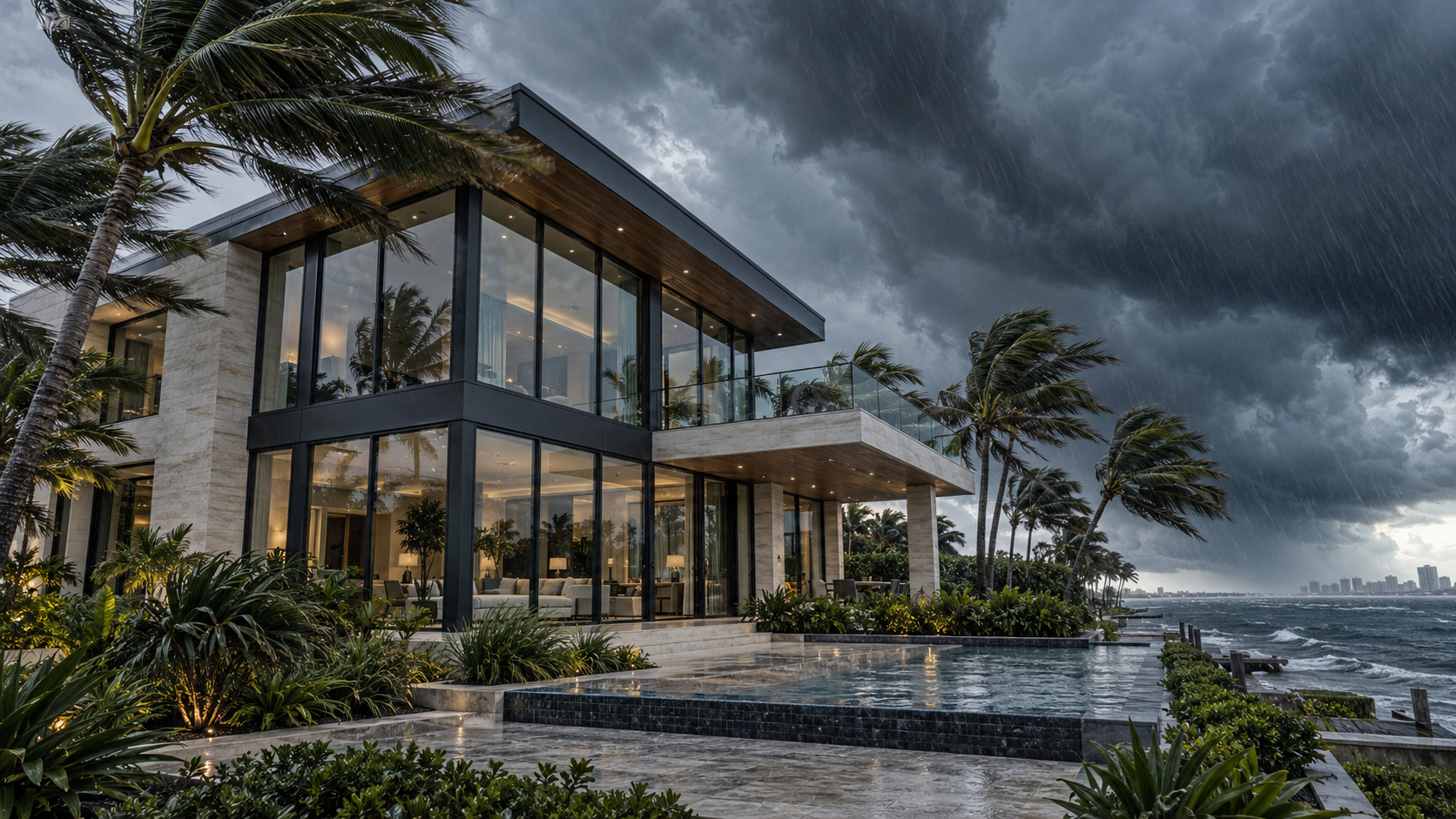
Florida Impact Windows: HVHZ, Miami-Dade NOA and Florida Product Approval
Image: AI-generated by GlassBase
In Florida, windows and shutters are covered by product approvals that you can check online. In Miami-Dade and Broward counties, the Florida Building Code's High-Velocity Hurricane Zone (HVHZ), the product needs an approval for HVHZ use. Miami-Dade County issues these approvals as Notices of Acceptance (NOAs). Statewide, the Florida Building Commission approves products through the Florida Product Approval system, and each approval has an FL number (FL#). Both records list the product's impact rating and its maximum design pressure. Before you sign a contract, ask for the NOA or FL# for every window and door and look it up yourself.
Updated: October 2026.
HVHZ: Miami-Dade and Broward vs. the rest of Florida
The Florida Building Code (8th Edition, 2023) defines the High-Velocity Hurricane Zone in one line: "This zone consists of Broward and Miami-Dade counties." In the Building volume, Sections 1616 to 1625 cover HVHZ structural requirements and Section 1626 covers HVHZ impact tests for wind-borne debris. The Residential volume points buildings in the HVHZ to Chapter 44 and a list of other sections.
Miami-Dade County says it "has the most advanced code requirements of the Florida Building Code" because it is in the HVHZ. The county requires approval for building-envelope products, including "doors, shutters, windows, prefabricated buildings, roofing and truss connectors."
Outside the HVHZ, the Florida Building Code still requires protection in wind-borne debris regions. The Residential volume (Section R301.2.1.2) states: "Exterior glazed openings in buildings located in windborne debris regions shall be protected from windborne debris." Protection can come from impact-rated windows and doors or from separate impact protective systems such as shutters. The code lists these acceptable impact test standards:
- The large missile test of ASTM E1996 and ASTM E1886
- Miami-Dade testing protocols TAS 201, 202 and 203
- AAMA 506
- ANSI/DASMA 115, for glazed openings in garage doors
Whether your property is in a wind-borne debris region depends on the code's design wind speed for the site and the site's exposure. Your local building department can confirm the requirement for your address.
Miami-Dade NOA vs. Florida Product Approval (FL#)
| Miami-Dade Notice of Acceptance (NOA) | Florida Product Approval (FL#) | |
|---|---|---|
| Issued by | Miami-Dade County, Product Control Section | Florida Building Commission |
| Identifier format | File number, for example 01-0712.04 | FL number, ##### or #####.# |
| What the record shows | File status, file classification (such as "High velocity hurricane zone"), category, applicant, expiration date, impact rating, maximum design pressure (positive and negative), description and the NOA document as a PDF | Manufacturer, category, compliance method, quality assurance entity, approval for use in the HVHZ (yes/no), approval for use outside the HVHZ (yes/no), impact resistant (yes/no), design pressure, limits of use and installation instructions |
| Where to look it up | Miami-Dade Product Control Search | Florida Product Approval search |
The Miami-Dade NOA. Miami-Dade's Product Control Section "receives applications for product approval and processes, reviews and issues approval or denial" of building envelope products. Its main products are windows, exterior glazing, wall cladding, roofing, exterior doors, skylights, glass block, siding and shutters. The laboratories that run the tests must also be certified by the county, and the section audits manufacturers for quality assurance. The county says it processes about 1,250 product approval applications a year and conducts more than 850 quality assurance audits of manufacturers, fabricators and laboratories. Miami-Dade advises residents to look for the "Miami-Dade County Product Approved" seal or mark on products.
Florida Product Approval. Section 553.842 of the Florida Statutes sets up a statewide product evaluation and approval system that works with the Florida Building Code. It covers "panel walls, exterior doors, roofing, skylights, windows, shutters, impact protective systems, and structural components." A product can be approved through a certification mark or listing, a test report from an approved laboratory, or an evaluation report from an approved evaluation entity or a Florida-licensed engineer or architect. The statute names Miami-Dade County's Product Control Division as one of the evaluation entities the Commission approves. Once a product has statewide approval, local jurisdictions may not require more testing or evaluation as a condition of using it. A building official can still deny a specific use of the product in a written report that finds the use is inconsistent with the approval.
How to look up an approval
- Get the numbers in writing. Ask for the NOA number or FL# for each window and door in the quote.
- NOA: open the Miami-Dade Product Control Search and enter the file number in Basic Search. To browse instead, Advanced Search filters by applicant, category, material, impact rating and maximum design pressure (+ and −). Check that the file status is current and note the expiration date.
- FL#: open the Florida Product Approval search, enter the FL# and choose the code version that applies to your permit. The search page notes that the 2023 Florida Building Code took effect on December 31, 2023. If you don't have the number, search by manufacturer. On the record, check "Approved for use in HVHZ" if you are in Miami-Dade or Broward, along with "Impact Resistant," the design pressure and the limits of use.
- Read the installation instructions. Florida approval records include installation instructions. Ask the installer to confirm the installation will follow them.
Design pressure basics
Design pressure (DP) is the wind load a window or door is rated to withstand, measured in pounds per square foot (psf) or pascals (Pa). Approvals list it as a positive (+) and a negative (−) value.
Each opening on a building has its own required design pressure. It is calculated under the Florida Building Code's wind provisions from the design wind speed for the site and the site's exposure. Compare the required value for each opening with the rated values and the limits of use in the product's approval.
DP alone is not the full picture. The Fenestration and Glazing Industry Alliance (FGIA) notes that a Performance Grade (PG) under the North American Fenestration Standard (AAMA/WDMA/CSA 101/I.S.2/A440) means the product passed the design pressure test and every other requirement of the standard, including air infiltration, water penetration resistance and structural tests. FGIA advises checking that certification shows the full PG, not only a DP rating. You can search certified products in the FGIA Certified Products Directory.
Energy ratings still matter
Impact resistance and energy performance are separate ratings. Compare U-factor and solar heat gain coefficient (SHGC) on the NFRC label. ENERGY STAR advises people in the South to "look for lower SHGC levels (0.23 and less)." To estimate heating and cooling effects for your ZIP code and wall orientation, use the GlassBase window energy calculator. For background, see low-E glass and ENERGY STAR windows.
What to ask an installer
- What is your license number, and which board issued it? Check it in the Florida DBPR license search, which searches by name, license number, city or county, and license type.
- What is the NOA number or FL# for each product, and is it approved for the HVHZ if the house is in Miami-Dade or Broward?
- What design pressure does each opening require, who calculated it, and does the product's rating cover it at the size being installed?
- Are the windows impact-rated, or will openings be protected by shutters? Which approval covers the shutters?
- Who obtains any required building permit and schedules the inspections?
- What are the U-factor and SHGC on the NFRC label for each window?
GlassBase is an independent directory and does not sell or install windows. Company profiles show information as reported by each company. Verify licenses and approvals at the official sources above.
Find window companies in Florida
Miami-Dade County (HVHZ): Miami, Miami Beach, Miami Gardens, Hialeah, Homestead, Opa-locka.
Broward County (HVHZ): Fort Lauderdale, Hollywood, Pompano Beach, Coral Springs, Deerfield Beach, Hallandale, Dania.
Rest of Florida: West Palm Beach, Boca Raton, Tampa, St. Petersburg, Orlando, Jacksonville, Sarasota, Fort Myers, Cape Coral, Tallahassee, Pensacola, Gainesville.
Compare window options for your Florida ZIP code in the calculator
Sources
- Florida Building Code, 8th Edition (2023), Building, Section 202 definition "High-Velocity Hurricane Zone," and the Chapter 16 table of contents (Sections 1616–1626); Residential, Sections R301.1 (HVHZ exception) and R301.2.1.2 (protection of openings). Read through UpCodes. The official viewer is at codes.iccsafe.org.
- Miami-Dade County, Product Approval (Product Control Section scope, certified laboratories, application and audit volumes)
- Miami-Dade County, Product Control Search (file number format; advanced search fields) and an example product record (record fields)
- Miami-Dade County news release, county-approved building materials ahead of the 2025 hurricane season (April 30, 2025)
- Florida Building Commission, Product Approval search (FL# format, code versions, 2023 FBC effective date) and an example product approval record (record fields)
- Florida Statutes, Section 553.842, Product evaluation and approval (subsections 1, 4, 5, 8 and 9)
- FGIA, Understanding Fenestration Performance Classes and Certified Products Directory
- Florida DBPR, Licensing Portal – License Search
- US EPA, ENERGY STAR, High Performing Windows or Storm Windows (SHGC advice for the South)

Other related articles
Get our latest articles!
New and better



Subscribe to updates
Get the latest guides and industry news delivered to your inbox.