Energy Star Windows: Requirements, Ratings & How to Qualify
Image: GlassBase
ENERGY STAR: The National for Energy Efficiency
Energy Star windows are the national benchmark for residential window efficiency in the United States, helping homeowners reduce heating and cooling costs while meeting strict federal performance standards. Backed by the U.S. Environmental Protection Agency (EPA) and the Department of Energy (DOE), the label confirms that a specific window configuration complies with regional efficiency criteria based on verified testing data.
For manufacturers, certification is not a marketing slogan—it is a regulated compliance pathway. To qualify, products must meet clearly defined Energy Star window requirements, supported by independently certified performance metrics, including NFRC. For homeowners, the label simplifies complex technical comparisons and provides confidence that the window meets enhanced efficiency standards for their region.
Who Should Care?
Homeowners planning to replace aging windows should pay close attention to the ENERGY STAR label, as it directly affects long-term energy savings and indoor comfort. Buyers of newly constructed homes should confirm that the specified windows meet current ENERGY STAR criteria, especially as codes and efficiency standards continue to tighten. Contractors benefit from offering certified products because they reduce liability, strengthen project credibility, and may help clients qualify for rebates or tax incentives. Manufacturers entering the U.S. market should understand that ENERGY STAR certification is often a baseline requirement for distribution, partnerships, and competitive positioning nationwide.
- What is ENERGY STAR for Windows?
- Energy Star Window Requirements (2026)
- U.S. Energy Star Climate Zones
- Energy Star U-factor
- Solar Heat Gain Coefficient (SHGC)
- Air Leakage
- How U-Factor and SHGC Affect Energy Performance
- How to Check Whether a Window Meets ENERGY STAR Standards
- 1. Look for the NFRC Label
- 2. Compare Values to ENERGY STAR Criteria
- 3. Verify in a Certification Database
- Why Energy Calculations Matter
- Calculate Window Energy Performance
- FAQ
What is ENERGY STAR for Windows?
ENERGY STAR for windows is a federal certification program that identifies residential windows, doors, and skylights that meet defined energy-performance thresholds. It is administered by the EPA in partnership with the DOE.
The EPA does not test individual window models directly. Instead, it establishes performance thresholds and relies on third-party certification programs to verify compliance. The most important of these is the National Fenestration Rating Council (NFRC). Certified NFRC window ratings provide standardized, independently tested values that allow direct comparison between products.
Before a manufacturer can claim compliance with ENERGY STAR window requirements, the product must have certified NFRC ratings. These ratings provide standardized, independently verified performance values that can be compared across brands.
In short:
- NFRC provides the numbers.
- ENERGY STAR confirms whether those numbers meet federal efficiency criteria.
Energy Star Window Requirements (2026)
As of 2026, requirements are governed by ENERGY STAR Version 7.0 (effective October 23).
U.S. Energy Star Climate Zones
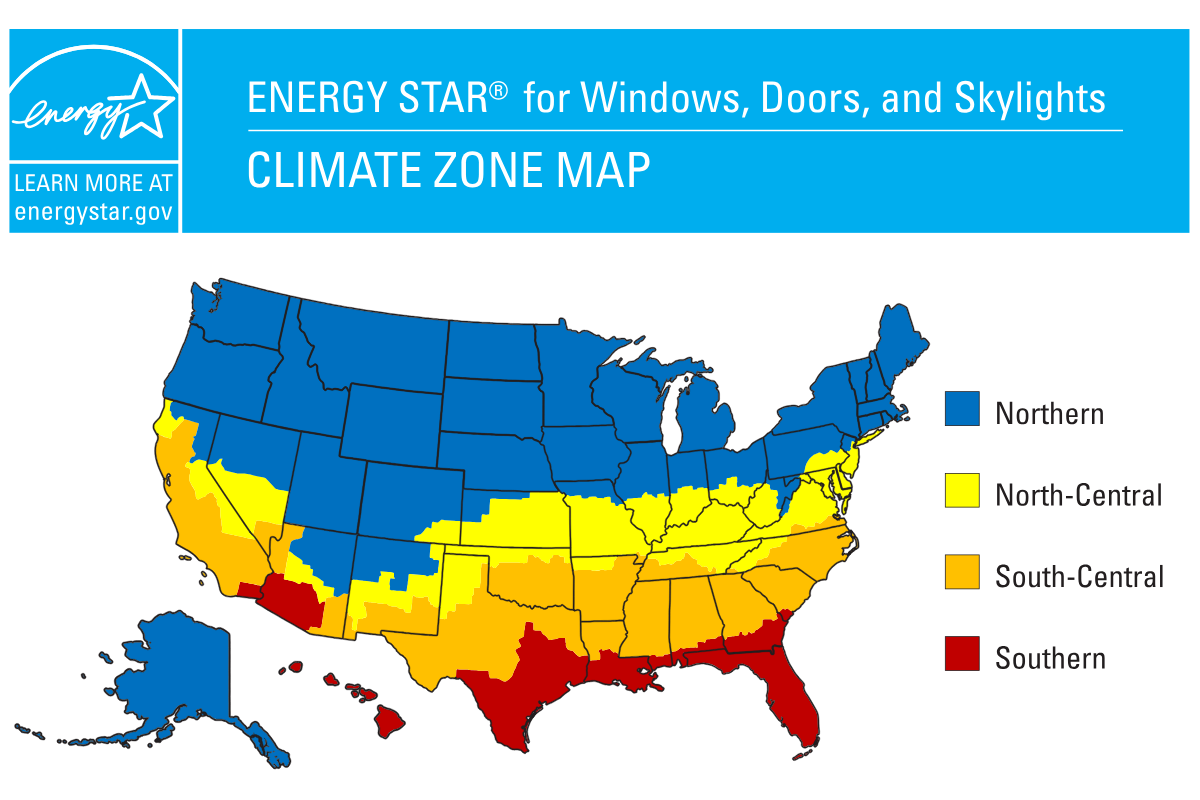
The United States is divided into four primary climate zones for window qualification:
| Climate Zone | General Region | Primary Efficiency Focus |
|---|---|---|
| Northern | Upper Midwest, Northeast | Strong insulation (low U-factor) + balanced SHGC |
| North-Central | Mid-Atlantic, parts of Midwest | Balanced insulation and solar control |
| South-Central | Southeast, parts of Texas | Reduced solar gain (lower SHGC) |
| Southern | Southern Florida, Southwest | Strong solar control (lowest SHGC) |
ENERGY STAR qualification is based primarily on technical performance metrics:
Energy Star U-factor
The U-factor measures how quickly heat flows through the entire window assembly (glass, frame, spacer). It is expressed in Btu/h·ft²·°F.
- Lower is better.
- A lower U-factor means less heat escapes in winter and less unwanted heat enters in summer.
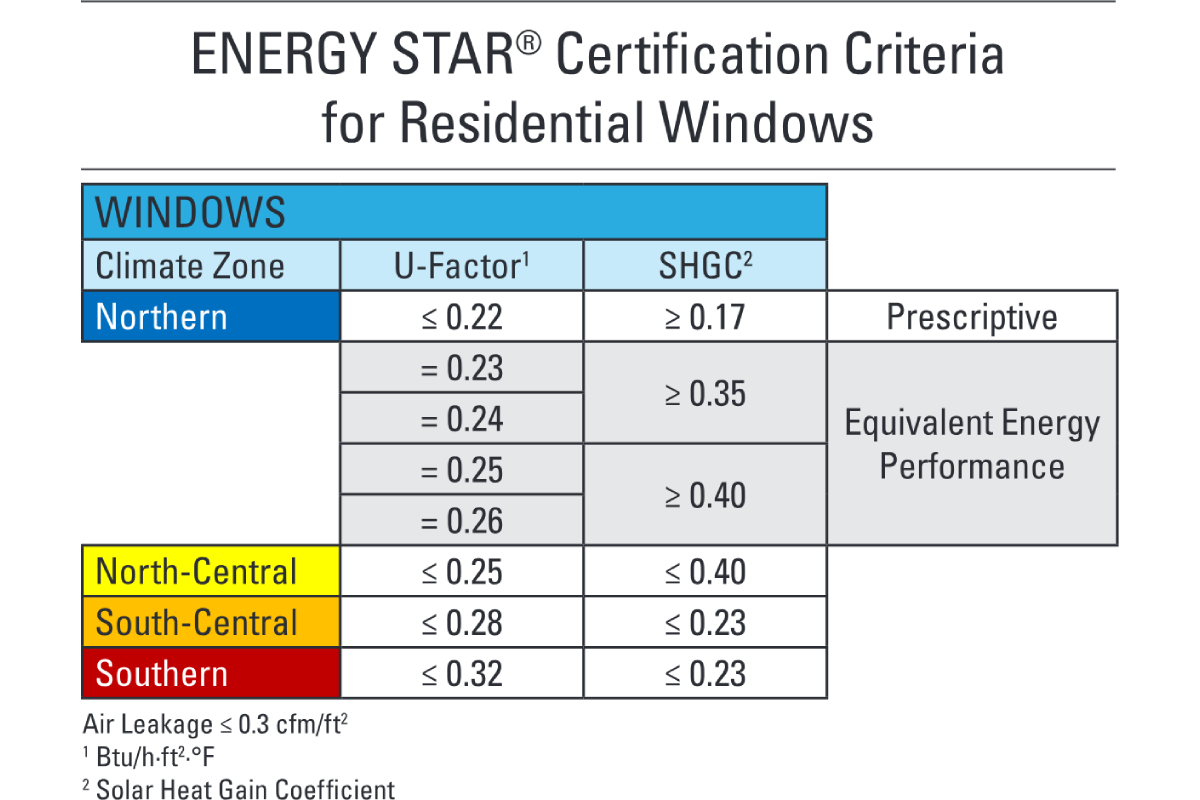
Typical residential window U-factors range from about 0.25 to 1.25. ENERGY STAR sets maximum allowable values by region. In colder climates, the maximum U-factor must be significantly lower to ensure strong insulating performance.
Reducing the U-factor directly lowers heating demand in cold weather. For example, replacing a U-0.45 window with a U-0.27 model in a northern state can significantly reduce conductive heat loss over the heating season.
Solar Heat Gain Coefficient (SHGC)
SHGC measures how much of the sun’s heat passes through a window. It ranges from 0 to 1.
- Lower SHGC = less solar heat enters.
- In hot climates, a lower SHGC helps reduce cooling costs.
- In cold climates, some solar gain can be beneficial.
Under Energy Star Version 7.0, the Northern zone includes a minimum SHGC requirement to prevent excessive blocking of useful winter sunlight. In contrast, the Southern and South-Central regions require low SHGC values (≤ 0.23), since cooling is typically the dominant energy load.
Air Leakage
Version 7.0 also includes an air leakage requirement of ≤ 0.3 cfm/ft² for windows. While not climate-specific, this limit helps ensure basic resistance to drafts.
How U-Factor and SHGC Affect Energy Performance
Window energy performance is not determined by a single number.
- In cold climates, reducing the U-factor has the greatest impact on energy savings.
- In hot climates, lowering SHGC often matters more.
- In mixed climates, both metrics must be balanced.
For example, if a home in Minnesota replaces a U-0.45 window with one rated U-0.27, winter heat loss through the window drops significantly. The heating system runs less often, reducing energy use.
In Arizona, a window with an SHGC of 0.40 allows 40% of solar heat to pass through—raising indoor temperatures and cooling costs. In colder climates, however, an extremely low SHGC can block beneficial winter sunlight. That is why Version 7.0 includes a minimum SHGC requirement in the Northern zone.
A very low-SHGC window installed on a south-facing wall in a northern state may reduce helpful winter solar gain. Conversely, a high-SHGC window on a west-facing wall in Arizona can sharply increase cooling demand during peak afternoon hours.
Orientation, shading, total window area, HVAC efficiency, and local energy costs all influence real-world performance.
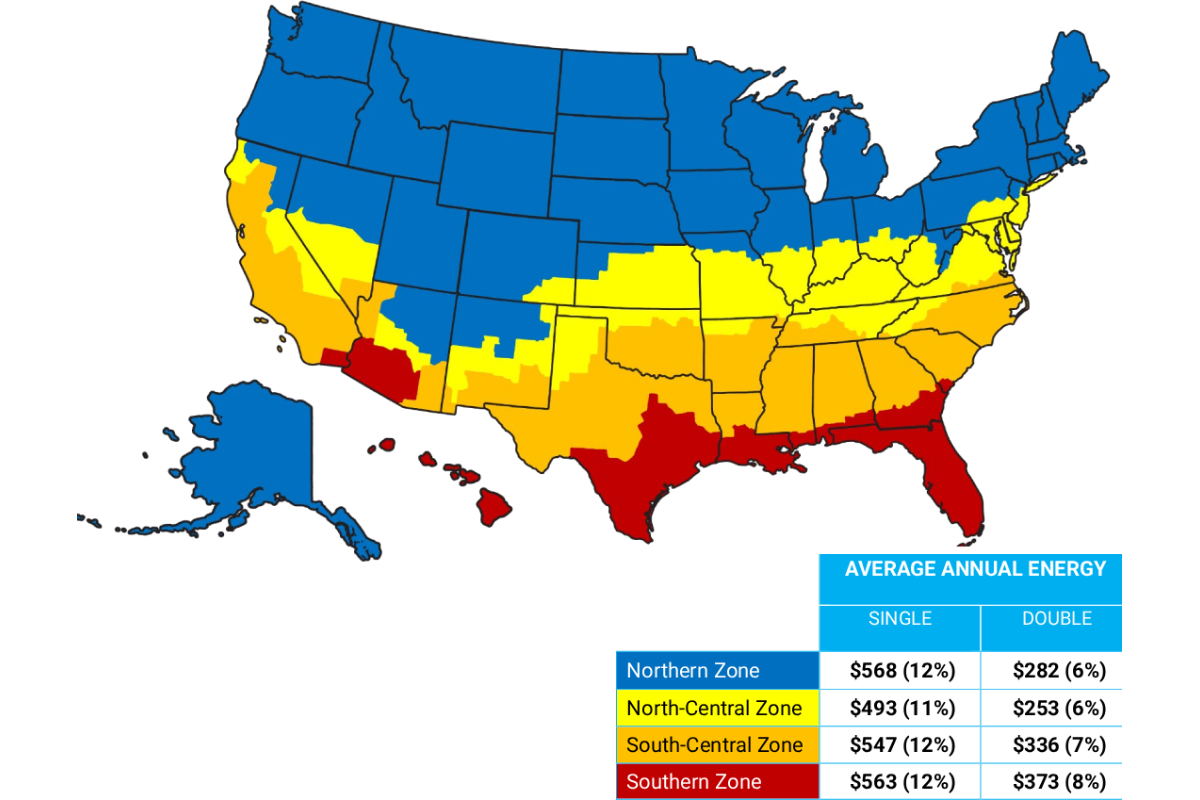
ENERGY STAR published modeled savings for a “typical home” (2,376 sq. ft., two-story single-family) undergoing a full window replacement with ENERGY STAR Version 7.0 windows.
- In the Southern Zone, replacing older double-pane clear windows with ENERGY STAR windows saves an average of about $373 per year (8%).
- Replacing single-pane clear windows in the same zone results in average modeled savings of about $563 per year (12%).
This qualifies as an “example” because it is an official ENERGY STAR savings estimate based on EnergyPlus modeling across 132 U.S. cities, using EIA state-average electricity and natural gas prices. It reflects a realistic “typical household” scenario, even though it is not based on one specific family’s utility bills.
How to Check Whether a Window Meets ENERGY STAR Standards
1. Look for the NFRC Label
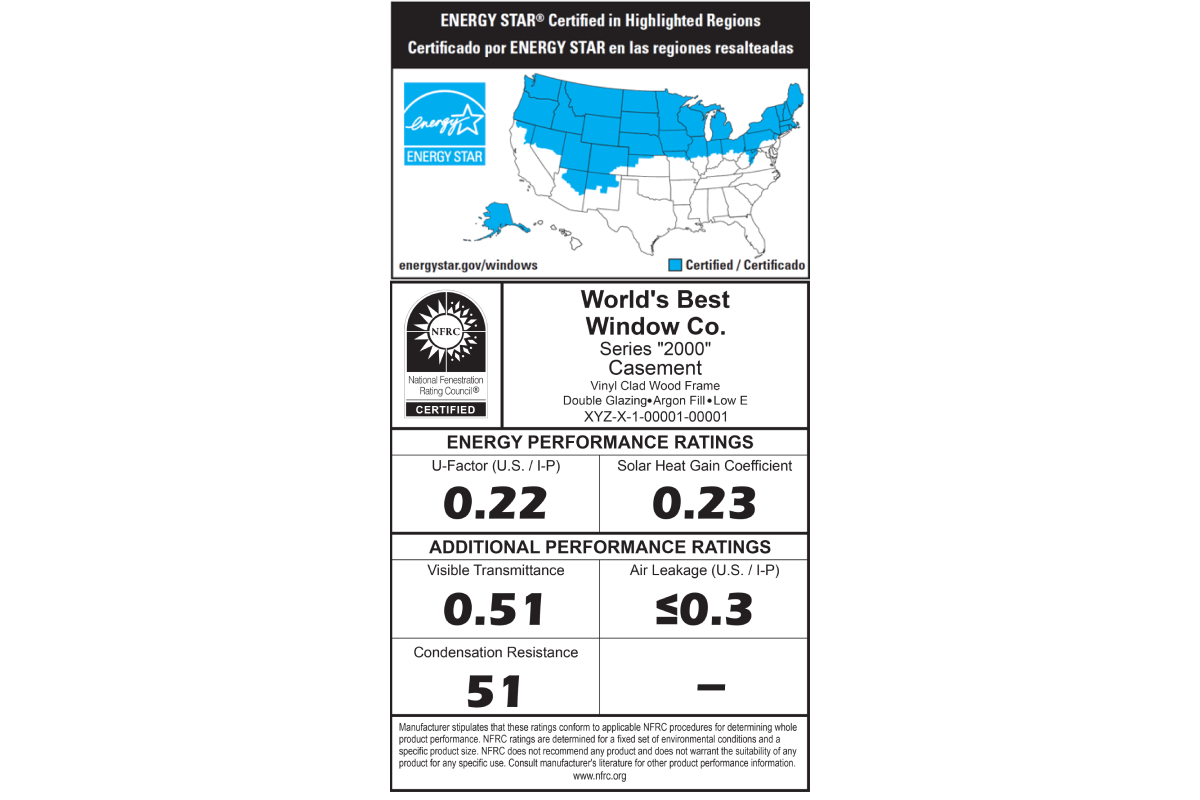
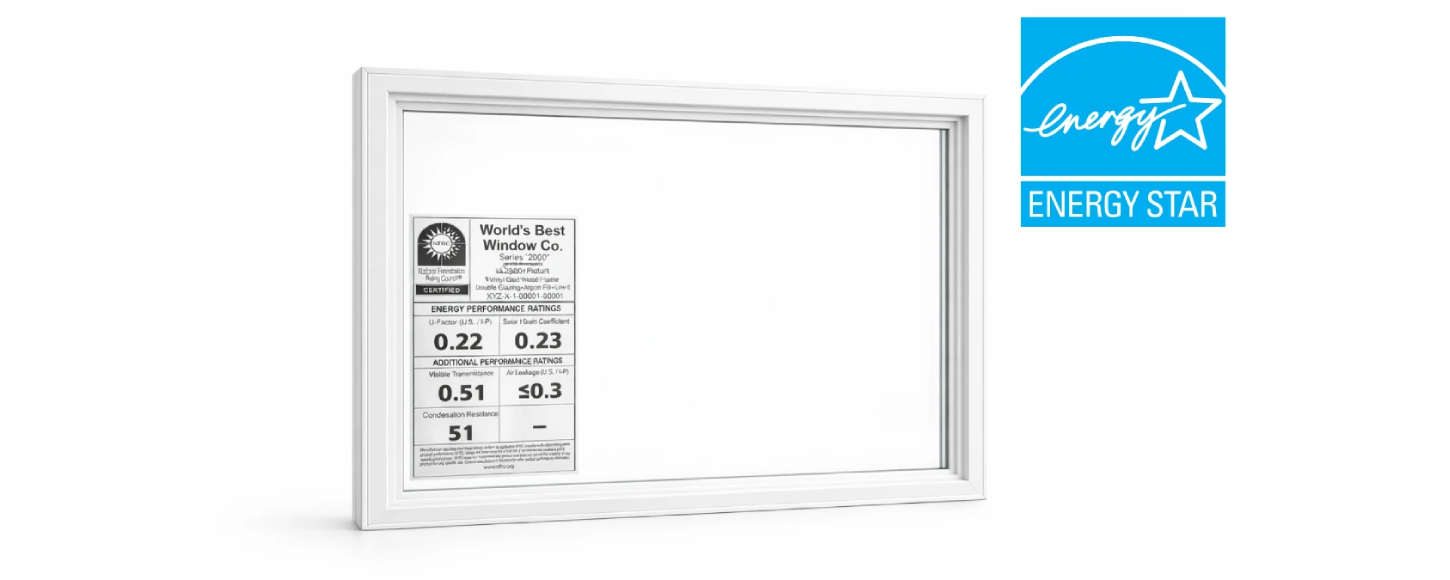
Every certified window must have an NFRC temporary or permanent label showing:
- U-factor
- SHGC
- Visible Transmittance
- Air Leakage (if tested)
These values are configuration-specific. Product line, glazing package, frame material, size, and operability type all affect the final rating.
2. Compare Values to ENERGY STAR Criteria
Check whether the certified NFRC U-factor and SHGC meet the thresholds for your climate zone.
3. Verify in a Certification Database
Manufacturers participating in ENERGY STAR are listed in the ENERGY STAR Product Finder ↗️. NFRC also maintains directories of certified products.
If a product claims ENERGY STAR compliance but lacks NFRC documentation, treat the claim as unverified.
Why Energy Calculations Matter
Real-world energy performance depends on:
- Orientation (north/south/east/west)
- Shading conditions
- Total glazing area
- HVAC system type and efficiency
Two ENERGY STAR–certified windows with similar ratings can perform differently depending on how and where they are installed. For example, west-facing windows often experience the highest cooling loads due to afternoon sun.
Window energy calculators allow homeowners and professionals to estimate actual window performance rather than relying solely on certification thresholds.
Calculate Window Energy Performance
Not sure whether your window meets ENERGY STAR requirements?
Use our Window Energy Calculator to check U-factor, SHGC, and overall performance instantly.
FAQ
What U-factor qualifies for ENERGY STAR?
It depends on climate zone. For example, in the Northern zone under Version 7.0, windows generally must meet a maximum U-factor around 0.28. Southern zones allow higher U-factors but require lower SHGC.
Does ENERGY STAR vary by climate zone?
Yes. EPA establishes different U-factor and SHGC thresholds for Northern, North-Central, South-Central, and Southern zones (Source: energystar.gov).
Is NFRC certification required for ENERGY STAR?
Yes. ENERGY STAR qualification is based on certified NFRC ratings. Without NFRC-verified U-factor and SHGC values, a window cannot qualify.
Top illustration was created with AI assistance based on publicly available information from energystar.gov and nfrc.org.
Other related articles


Get our latest articles!
New and better



Subscribe to updates
Get the latest guides and industry news delivered to your inbox.