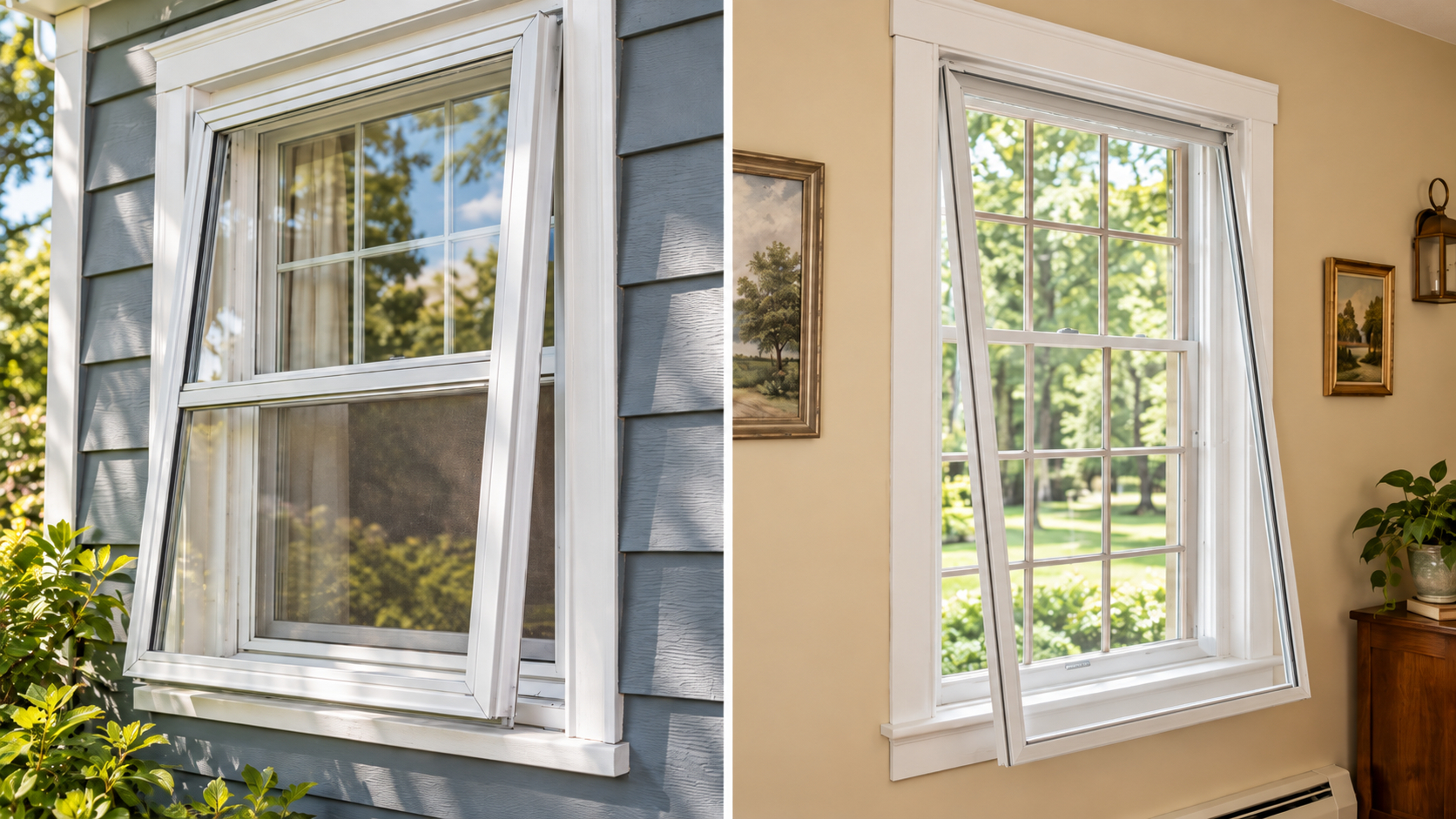
Storm Windows vs. Replacement Windows
Image: AI-generated by GlassBase
If your windows still open, close and hold together, a low-E storm window is usually the cheaper way to cut heat loss, and the savings come close to what replacement delivers. The US Department of Energy (DOE) says low-E storm windows "cost about a quarter of what full window replacement would cost but bring similar energy savings" when installed over a low-performing window. Replacement is the better call when the sash or frames are rotted or broken. Storm windows are also a poor fit in very hot, sunny climates where the house already has double-pane or low-E glass. The published savings figures below all start from single-pane, clear-glass or otherwise low-performing windows, so check how close your house is to that case.
Updated: October 2026.
What a storm window is
A storm window is an extra glazed unit attached to the window you already have. Exterior storm windows go on the outside of the primary window and interior ones on the inside, and both come in operable and fixed models. A replacement window takes the old unit out entirely. ENERGY STAR certified primary windows "have a full frame and at least two layers of glass."
Most of the energy benefit comes from the coating. ENERGY STAR certified storm windows use low-E glass, a "microscopically thin, almost invisible, durable coating that reduces heat loss through the window glass when it is cold outside." Some low-E glass also has a low solar transmittance (Tsol), which keeps out heat in summer. For how low-E coatings work in standard insulating glass, see low-E glass.
What the official figures say
These are national averages or test-home results. Each row gives the basis the source states.
| Option | Published figure | Basis stated by the source | Source |
|---|---|---|---|
| Add ENERGY STAR certified (low-E) storm windows | "About 10%" off annual heating and cooling bills; incremental cost paid back "in about three (3) years" | National average, installed over single-pane clear glass windows without existing storm windows | EPA, ENERGY STAR, Storm Windows |
| Add ENERGY STAR certified (low-E) storm windows | "About 20%" on annual heating and cooling bills; payback "in about three (3) years" | National average, installed over single-pane clear glass windows without existing storm windows | EPA, ENERGY STAR, High Performing Windows or Storm Windows |
| Swap clear storm windows for low-E ones | "About 2%" more on heating and cooling | National average, single-pane windows that already have clear storm windows | EPA, ENERGY STAR, Storm Windows |
| Add a low-E storm window | Heating and cooling costs down 10% to 35% | Installed over a low-performing window; whole-home tests in PNNL's Lab Homes, 2013 to 2015 | DOE |
| Replace with ENERGY STAR certified windows | Bills lower "by an average of up to 13 percent nationwide" | When replacing single-pane windows | EPA, ENERGY STAR |
Two ENERGY STAR pages give different savings for the same case, about 10% and about 20%, and neither explains the gap. The 10% page calls its estimate conservative because it leaves out savings from sealing air leaks in older windows, which "can vary substantially from house to house." Take either number and the storm window is in the same range as replacement. The cost is not. ENERGY STAR puts storm windows at "½ to ¼ the amount of common replacement windows with much lower cost installation."
When storm windows make more sense
- The existing windows work. ENERGY STAR says storm windows "work best when installed over working primary windows that are in good condition."
- The glass is single-pane, or double-pane without low-E. Savings are largest over single-pane windows. Over clear double-pane windows you still save energy, "but you should expect a longer payback period."
- The house is historic. Storm windows let you keep the original sash. ENERGY STAR calls them a good option in neighborhoods with preservation rules, but check that those rules allow storm windows. Firms that restore old sash are listed under historic window restoration companies.
- Full replacement is hard to arrange. ENERGY STAR names lower-income households, low-rise multifamily buildings, HUD and weatherization programs, and historic districts as cases where certified storm windows are "an affordable option."
There is a side benefit too. ENERGY STAR says storm windows "can be an inexpensive way to reduce noise from outside."
When replacement makes more sense
- The windows are failing. If they are "rotted, not operating properly, or damaged beyond reasonable repair," ENERGY STAR says storm windows may not be appropriate and suggests certified replacement windows instead. If the damage is limited, a repair may be enough first; see window repair companies.
- Very hot, sunny climates with better glass already. Low-E storm windows can trap heat between the two layers. If you already have double-pane or low-E windows and the temperature often goes above 115°F, ENERGY STAR suggests awnings, solar screens or replacement with certified low-SHGC windows.
- Tinted glass. A low-E storm window over tinted glass may reduce visible light further and make the room darker.
If you replace, buy for your climate zone. The ENERGY STAR criteria for windows set U-factor and SHGC limits by zone; see ENERGY STAR windows.
What to check on a storm window
ENERGY STAR certifies storm windows under a specification effective September 5, 2018. The glazing must meet an emissivity limit and a solar transmittance limit for the climate zone:
| ENERGY STAR climate zone | Emissivity | Solar transmittance (Tsol) |
|---|---|---|
| Northern | ≤ 0.22 | > 0.55 |
| North-Central | ≤ 0.22 | Any |
| South-Central | ≤ 0.22 | ≤ 0.55 |
| Southern | ≤ 0.22 | ≤ 0.55 |
The air leakage rating must be 1.5 cfm/ft² or less for an exterior storm window and 0.5 cfm/ft² or less for an interior one. The Northern limit is a minimum on purpose: ENERGY STAR says products for Northern climates have "high-gain low-e coatings" to make use of solar heat in cold weather, while Southern products are low-gain and block solar heat to lower air conditioning costs. Every certified storm window carries a label with a map showing the zones it is certified for. The ENERGY STAR Product Finder lists certified models.
ENERGY STAR's buying guidance adds a few practical checks:
- Exterior storm windows need weep holes or another way to drain moisture from the space between the two windows. Exterior units without them cannot be certified.
- Over metal-framed windows, use thermal breaks. Storm window frames are typically aluminum and will conduct heat and cold.
- Match the operability of the existing window, especially in bedrooms and other rooms where building codes may require an emergency escape and rescue opening.
- Local codes may require safety glass in some places, near stairs for example.
- Every ENERGY STAR storm window must include, or link to, detailed installation instructions. A poor installation cuts the savings.
Some storm windows also carry an AERC label. The Attachments Energy Rating Council is a nonprofit, formed in 2014, that rates, labels and certifies window attachments, storm windows and panels among them. DOE describes the label as two ratings, one for cool climates and one for warm climates, each on a scale from 0 to a "Max" that differs by product category; the closer to Max, the better. AERC and ENERGY STAR are separate programs, so an AERC label is not an ENERGY STAR certification.
Compare your own windows
A national average won't tell you how much your north-facing windows lose in January. The GlassBase window energy calculator estimates heating and cooling energy in kWh for a window at your ZIP code and wall orientation. Set up a configuration close to your current window, then a replacement option, and compare the two. Start with kWh, because your utility rate sets the dollar value. The results are engineering estimates, not NFRC ratings; the method is explained in how the GlassBase window performance simulator works.
With that number in hand, price both routes. GlassBase is an independent directory and does not sell or install windows; to find installers, browse window companies by city.
Estimate heating and cooling energy for your ZIP code
Sources
- US EPA, ENERGY STAR, Storm Windows (about 10% and about 2% national averages; about 3-year payback; buying guidance; specification effective September 5, 2018). Fetched October 7, 2026.
- US EPA, ENERGY STAR, Storm Windows Key Product Criteria (emissivity, solar transmittance and air leakage limits). Fetched October 7, 2026.
- US EPA, ENERGY STAR, High Performing Windows or Storm Windows (about 20%; about 3-year payback; ½ to ¼ the cost of replacement; Northern and Southern coatings). Fetched October 7, 2026.
- US EPA, ENERGY STAR, Residential Windows, Doors and Skylights (up to 13% when replacing single-pane windows). Fetched October 7, 2026.
- US DOE, Performance Validation of Low-e Storm Windows (10% to 35%; about a quarter of replacement cost; PNNL Lab Homes testing 2013 to 2015). Fetched October 7, 2026.
- US DOE, Building Technologies Office, New Program Allows Manufacturers to Certify Energy Performance of Window Attachment Products and Materials (February 15, 2018; AERC and its label). Fetched October 7, 2026.

Other related articles

-378x274.jpg)
Get our latest articles!
New and better



Subscribe to updates
Get the latest guides and industry news delivered to your inbox.